Can a Car Dent Be Repaired Without Replacing the Panel?
You walk out to your car and notice a dent in the door. Or maybe another vehicle bumped your fender in a parking lot.
After a minor collision, you might be looking at a damaged body panel wondering:
Does the whole panel really need to be replaced?
Not always.
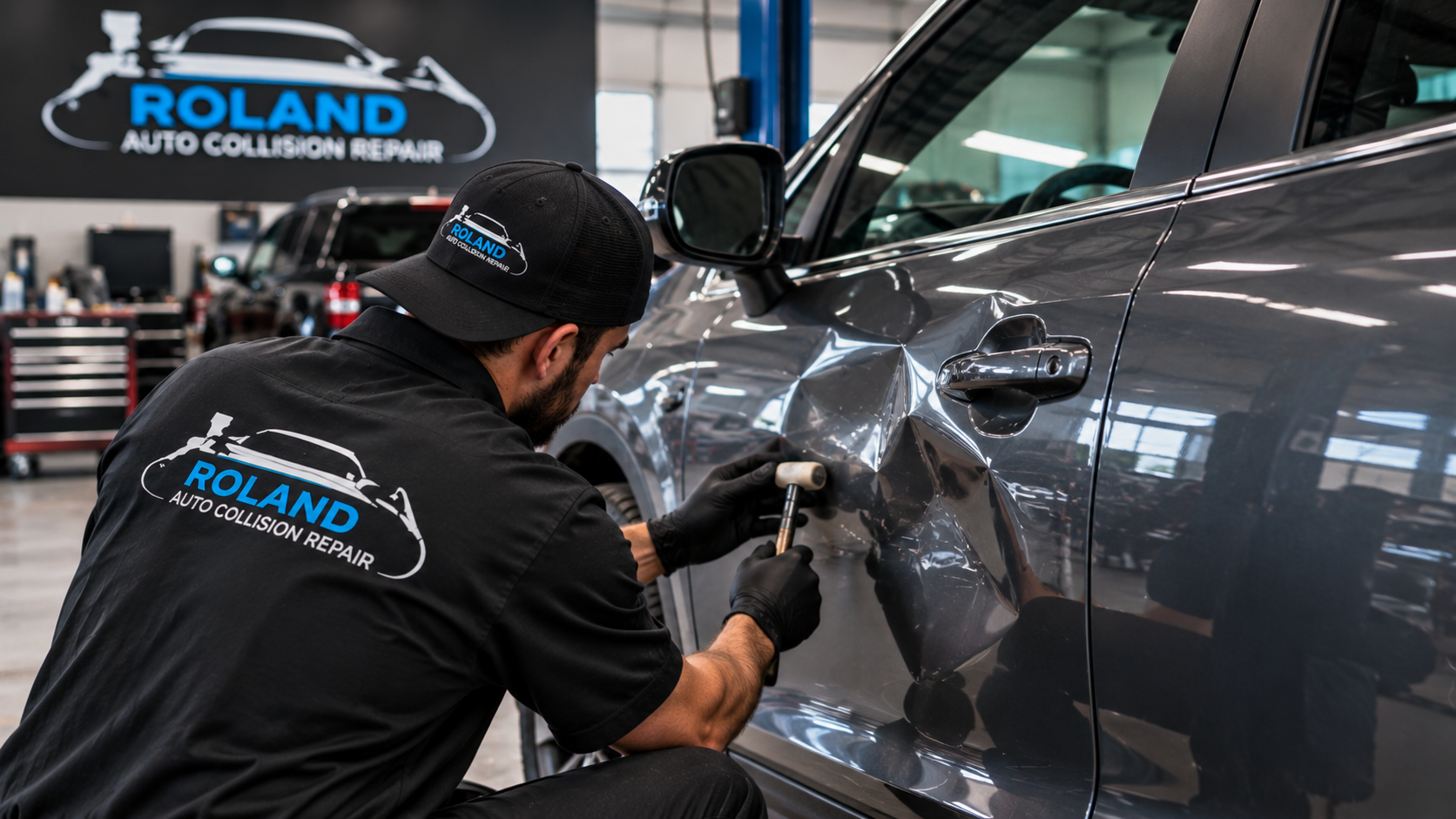
Depending on the location, depth, size, paint condition, and type of damage, an auto body technician may be able to repair the existing panel rather than replace it.
At Roland Auto Collision Repair LLC in Duluth, GA, we inspect dents and collision damage to determine the appropriate repair approach for each vehicle.
If your vehicle has a dent, crease, scratch, or other body damage, call (770) 771-1027 to schedule an estimate.
What Determines Whether a Dent Can Be Repaired?
No two dents are exactly alike.
A shallow parking lot dent is very different from a sharply creased fender caused by a collision.
Before determining how a damaged panel should be repaired, several factors need to be considered.
The size of the damaged area matters.
Smaller dents may sometimes require less extensive repairs, while large areas of deformation can require considerably more body work.
But size alone doesn't determine whether a panel can be saved.
A relatively small dent in a difficult location can sometimes be more complicated than a larger, shallow dent.
How far the metal has been pushed or stretched can affect the repair.
A shallow dent may leave much of the original panel shape intact.
A deeper impact can stretch or distort the metal and create additional damage around the impact area.
That's why a technician needs to look at the actual vehicle rather than relying only on a picture.
Where the damage occurred is extremely important.
Common areas for dents include:
- Doors
- Fenders
- Quarter panels
- Hoods
- Trunks
- Roof panels
- Rocker panels
Damage near body lines, edges, seams, or structural areas can be more complicated to repair than damage in the center of a relatively flat panel.
A dent isn't always just a dent.
Look closely and you may also find:
- Scratches
- Chipped paint
- Cracked paint
- Scuff marks
- Exposed underlying material
If the paint has been damaged, the repair may require refinishing in addition to correcting the shape of the panel.
Professional paint work involves proper surface preparation and color matching so the repaired area blends appropriately with the rest of the vehicle.
A crease occurs when the impact creates a sharper line in the metal rather than a smooth depression.
Creases can be more challenging because the metal has been distorted along a concentrated area.
The severity and location of the crease help determine what repair approach is appropriate.
Repairing a Panel vs. Replacing It
When possible and appropriate, repairing the existing panel can preserve more of the vehicle's original components.
But there are situations where replacement may make more sense.
A technician may consider replacement when there is:
- Severe deformation
- Extensive collision damage
- Significant metal stretching
- Damage to important mounting areas
- Multiple severe creases
- Damage that prevents the panel from being properly restored
- Other underlying concerns
The goal isn't simply to choose whichever option sounds easier.
The goal is to determine an appropriate repair based on the actual condition of the vehicle.
What About Paintless Dent Repair?
You may have heard of paintless dent repair, commonly called PDR.
This technique can be useful for certain types of dents when the original paint remains intact and the location of the damage allows the panel to be manipulated appropriately.
However, not every dent is a candidate.
If a collision has caused significant paint damage, sharp creases, extensive deformation, or other body damage, conventional auto body repair may be necessary.
A professional inspection is the best way to determine the appropriate repair method.
What About Door Dents?
Door dents are extremely common.
They can happen from:
- Another vehicle's door
- Shopping carts
- Parking lot accidents
- Low-speed collisions
- Objects hitting the vehicle
A small door ding and a heavily creased door require very different repairs.
The technician also needs to consider components inside the door and whether the damage affects how the door opens, closes, or aligns with surrounding panels.
If your door no longer closes correctly after an accident, have it inspected.
What About Fender Dents?
Fenders frequently get damaged during front-corner impacts and parking lot accidents.
Depending on the impact, you might notice:
- Dents
- Scratches
- Cracked paint
- Panel gaps
- Damage around the wheel opening
If the fender has shifted enough to interfere with the tire or another component, the vehicle should be evaluated before continuing to drive it normally.
What About Quarter Panel Damage?
Quarter panels can be more involved because they're typically integrated differently into the vehicle's body than some bolt-on components.
Damage can range from a small dent to significant collision deformation.
Because of this, quarter panel repairs should be evaluated individually.
The technician needs to consider the extent of the damage, surrounding body structure, paint work, and the appropriate repair procedure for that vehicle.
Can You Fix a Dent That Also Has Scratches?
Potentially, yes.
The body damage and paint damage can be addressed as different parts of the repair process.
The panel may first require body work to restore its shape.
Then the surface can be prepared for refinishing when necessary.
Depending on the repair, this can involve:
- Evaluating the damaged panel
- Correcting the body damage
- Preparing the repair area
- Sanding and smoothing
- Applying primer where required
- Matching the vehicle's color
- Applying paint
- Applying clear coat
- Finishing the repaired area
The exact process depends on the vehicle and extent of the damage.
Should You Fix a Small Dent?
That depends on the damage and your preferences.
Some small dents may primarily be cosmetic.
However, it's worth having damage inspected if:
- Paint is cracked
- Metal is exposed
- The panel is severely creased
- A door doesn't close correctly
- Panels no longer line up
- The damage occurred during a collision
- There may be additional damage nearby
An estimate can help you understand what you're actually dealing with before making a decision.
Don't Judge Collision Damage From the Outside Alone
One of the biggest mistakes after an accident is assuming that visible damage tells the entire story.
For example, a damaged fender could be accompanied by damage to nearby mounting points or components.
A dented door could also have alignment issues.
A damaged quarter panel could be part of a larger impact area.
A professional inspection gives you a clearer understanding of what needs attention.
How Much Does Dent Repair Cost in Duluth, GA?
The price depends on the vehicle and the damage.
Factors can include:
- Size of the dent
- Depth
- Location
- Number of damaged panels
- Paint condition
- Labor required
- Whether refinishing is necessary
- Whether the panel can be repaired
- Whether replacement is required
- Additional collision damage
That's why generic online prices can be misleading.
Two dents that look similar in photographs can require very different repairs.
Dent Repair in Duluth, GA
If your car has a dent from an accident, parking lot incident, or another impact, let Roland Auto Collision Repair LLC inspect it.
Roland provides:
- Dent Repair
- Auto Body Repair
- Collision Repair
- Bumper Repair
- Paint Repair
- Scratch Repair
We'll evaluate the damage and help you understand the appropriate next step for your vehicle.
Get a Dent Repair Estimate in Duluth
Don't assume an entire body panel needs replacement just because it has been dented.
Let an auto body professional take a closer look.
Roland Auto Collision Repair LLC is located at 3430 Buford Hwy NE, Duluth, GA 30096. Call (770) 771-1027 to schedule your dent repair estimate.
Contact Roland Auto Collision Repair today to schedule an estimate for your damaged vehicle.
Frequently Asked Questions
Can a dented car panel be repaired instead of replaced?
Sometimes. Whether the existing panel can be repaired depends on the size, depth, location, paint condition, and severity of the damage.
Can you repair a dent if the paint is scratched?
Depending on the damage, body repair and refinishing can both be part of the repair process.
Do small dents need body work?
It depends on the dent. Some damage may be relatively minor, while other small-looking dents can involve sharp creases, paint damage, or difficult locations.
Can a dent from a car accident be repaired?
Many collision-related dents can be repaired, but the appropriate procedure depends on the severity of the impact and condition of the surrounding components.
Where can I get dent repair in Duluth, GA?
Roland Auto Collision Repair LLC is located at 3430 Buford Hwy NE, Duluth, GA 30096. Call (770) 771-1027 to schedule an estimate.
Need Collision Repair in Duluth?
Roland's Auto Collision is here to help with honest estimates, quality workmanship, and insurance claim assistance.