OEM vs. Aftermarket Parts After a Car Accident: What Georgia Drivers Need to Know
OEM vs. Aftermarket Parts After a Car Accident: What Georgia Drivers Need to Know
What Are OEM Auto Parts?
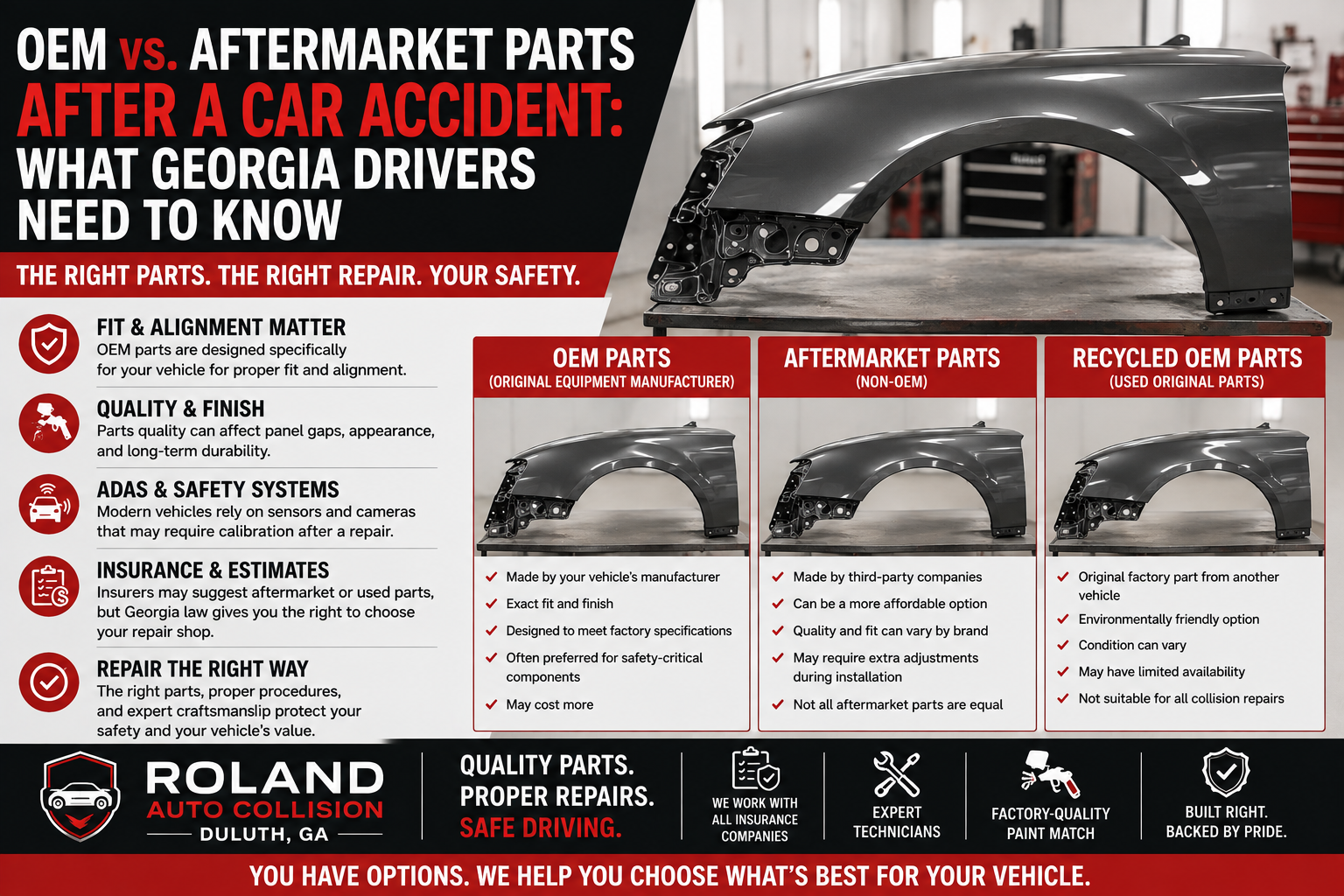
OEM stands for Original Equipment Manufacturer.
Generally, an OEM replacement part comes from the vehicle manufacturer's parts supply chain and is designed for a particular vehicle application.
Depending on the repair, examples can include:
- Bumper components
- Fenders
- Hoods
- Doors
- Headlights
- Brackets
- Trim
- Structural components
- Sensors
- Other vehicle-specific parts
One major advantage of OEM parts is that they are produced for the specific vehicle application.
However, parts selection after an accident can involve several considerations, including availability, repair procedures, insurance coverage, vehicle age, and the specific component being replaced.
What Are Aftermarket Collision Parts?
Aftermarket parts are manufactured by companies other than the original vehicle manufacturer.
The aftermarket industry is enormous, and quality can vary depending on the manufacturer and component.
An aftermarket part may be designed to replace an original component while potentially costing less.
That doesn't automatically make every aftermarket part bad.
Likewise, simply labeling a part "aftermarket" doesn't mean it will be identical to an OEM component in every respect.
The specific part and repair situation matter.
What Are Recycled or Used OEM Parts?
Another category drivers may encounter is recycled parts.
These are original parts removed from another vehicle rather than newly manufactured replacement parts.
For certain non-safety-critical components, recycled OEM parts may sometimes be considered during the repair process.
Again, suitability depends on the component's condition, application, repair requirements, and other factors.
Why Does Parts Selection Matter After a Collision?
A vehicle is a collection of systems designed to work together.
A replacement component may affect:
- Panel fit
- Body gaps
- Appearance
- Mounting locations
- Corrosion protection
- Sensors
- Safety systems
- Repair procedures
That's why parts decisions shouldn't be viewed exclusively as a question of price.
The correct repair considers how the replacement component fits into the overall vehicle.
Fit and Finish Matter
You've probably seen a repaired vehicle where something simply looks "off."
Maybe the gap between the hood and fender isn't even.
Maybe a bumper doesn't line up properly.
Maybe a headlight appears slightly different from the opposite side.
Proper collision repair requires attention to fit, alignment, preparation, paint, and refinishing - not simply attaching a replacement panel.
Part quality can be one factor in achieving the desired result.
What About Paint Matching?
Replacement body parts generally require preparation and refinishing to match the vehicle.
Professional automotive refinishing involves more than finding a paint can with the same color name.
Paint appearance can vary due to age, finish, production variations, previous repairs, and other factors.
A collision repair shop may use paint codes, color-matching procedures, spray techniques, blending, and refinishing expertise to produce a consistent appearance.
The goal is for the repaired area to integrate naturally with the rest of the vehicle.
Do Replacement Parts Affect ADAS?
Modern vehicles may contain advanced technology integrated into or positioned around bumpers, mirrors, windshields, grilles, and other body components.
These systems can include:
- Blind-spot monitoring
- Forward collision warning
- Automatic emergency braking
- Adaptive cruise control
- Parking sensors
- Lane assistance
- Cameras
- Radar systems
When collision repairs involve areas containing ADAS components, the repair plan needs to account for the manufacturer's procedures and any required calibrations or related operations.
Parts selection can therefore be more complex on modern vehicles than simply comparing two pieces of sheet metal.
Does Insurance Decide Which Parts Are Used?
Insurance policies and repair estimates can differ.
An insurer may prepare or approve an estimate that specifies certain types of replacement parts based on the policy, vehicle, availability, and other considerations.
However, the repair process may change after the vehicle is disassembled and additional damage is discovered.
This is one reason the first estimate isn't always the final repair plan.
A professional collision shop can document necessary repairs and communicate with the insurance company during the repair process.
What Is a Collision Repair Supplement?
A supplement is an additional request or adjustment to an initial repair estimate when damage or necessary operations are identified that weren't included originally.
For example, exterior damage may hide broken brackets, damaged reinforcement components, sensors, or other parts.
Once the vehicle is disassembled, the shop can better understand the full scope of the repair.
Documentation can then be submitted to the insurer when appropriate.
Supplements are a normal part of many collision repairs because not all damage can be seen before disassembly.
Should You Automatically Demand OEM Parts?
Parts selection isn't always a simple "OEM good, aftermarket bad" decision.
The right approach is to consider:
- Vehicle manufacturer procedures
- Specific component
- Vehicle age
- Part availability
- Fit and quality
- Safety considerations
- Insurance policy
- Repair requirements
- ADAS involvement
An experienced collision repair shop can help explain the parts listed on the repair plan and why they are being considered.
Ask Questions About Your Collision Estimate
Drivers shouldn't be afraid to ask what is being repaired or replaced.
Good questions include:
- What type of replacement parts are listed on my estimate?
- Are these OEM, aftermarket, or recycled parts?
- Why is this part being replaced instead of repaired?
- Could additional damage be discovered after disassembly?
- Does this repair involve any sensors or ADAS systems?
- Will calibration be required?
Understanding your repair is better than simply handing over the keys without knowing what's being done.
Quality Collision Repair Is More Than Replacing Parts
The quality of an auto body repair depends on much more than the logo printed on a replacement component.
A proper repair can involve:
- Damage analysis
- Disassembly
- Structural inspection
- Parts selection
- Body repair
- Panel alignment
- Welding or attachment procedures
- Corrosion protection
- Surface preparation
- Paint matching
- Refinishing
- Reassembly
- ADAS considerations
- Quality-control inspection
Each step contributes to the finished repair.
OEM & Collision Repair in Duluth, GA
If you've been involved in a car accident and have questions about your insurance estimate, replacement parts, or repair process, Roland Auto Collision can help.
We provide professional auto body and collision repair for drivers throughout Duluth, Norcross, Suwanee, Johns Creek, Lawrenceville, Peachtree Corners, Gwinnett County, and surrounding areas.
Our goal is to help you understand what your vehicle needs and complete the repair with attention to quality, fit, finish, and safety.
Looking for an Auto Body Shop in Duluth, GA?
Don't choose a collision repair shop based solely on the lowest number on an estimate.
Ask questions about the repair process, replacement parts, hidden damage, paint work, and procedures being performed on your vehicle.
Contact Roland Auto Collision in Duluth, GA for professional collision repair and auto body service after an accident.
Need Collision Repair in Duluth?
Roland's Auto Collision is here to help with honest estimates, quality workmanship, and insurance claim assistance.