Rear-End Collision Damage in Duluth, GA: 11 Problems That Can Be Hidden After Getting Hit From Behind
Rear-end accidents are among the most common types of collisions.
They can happen at traffic lights, in stop-and-go traffic, at intersections, in parking lots, on highways, and during sudden braking.
Sometimes the visible damage looks surprisingly minor.
The bumper may only have a few scratches.
The trunk may still open.
The vehicle may even seem to drive normally.
But the force of a rear impact can travel through several components behind the bumper and potentially create damage that is not immediately visible.
For drivers in Duluth, Georgia, a professional collision inspection after being rear-ended can help identify problems before they become more serious.
At Roland Auto Collision Repair LLC, we inspect the full impact area rather than judging damage by the bumper cover alone.
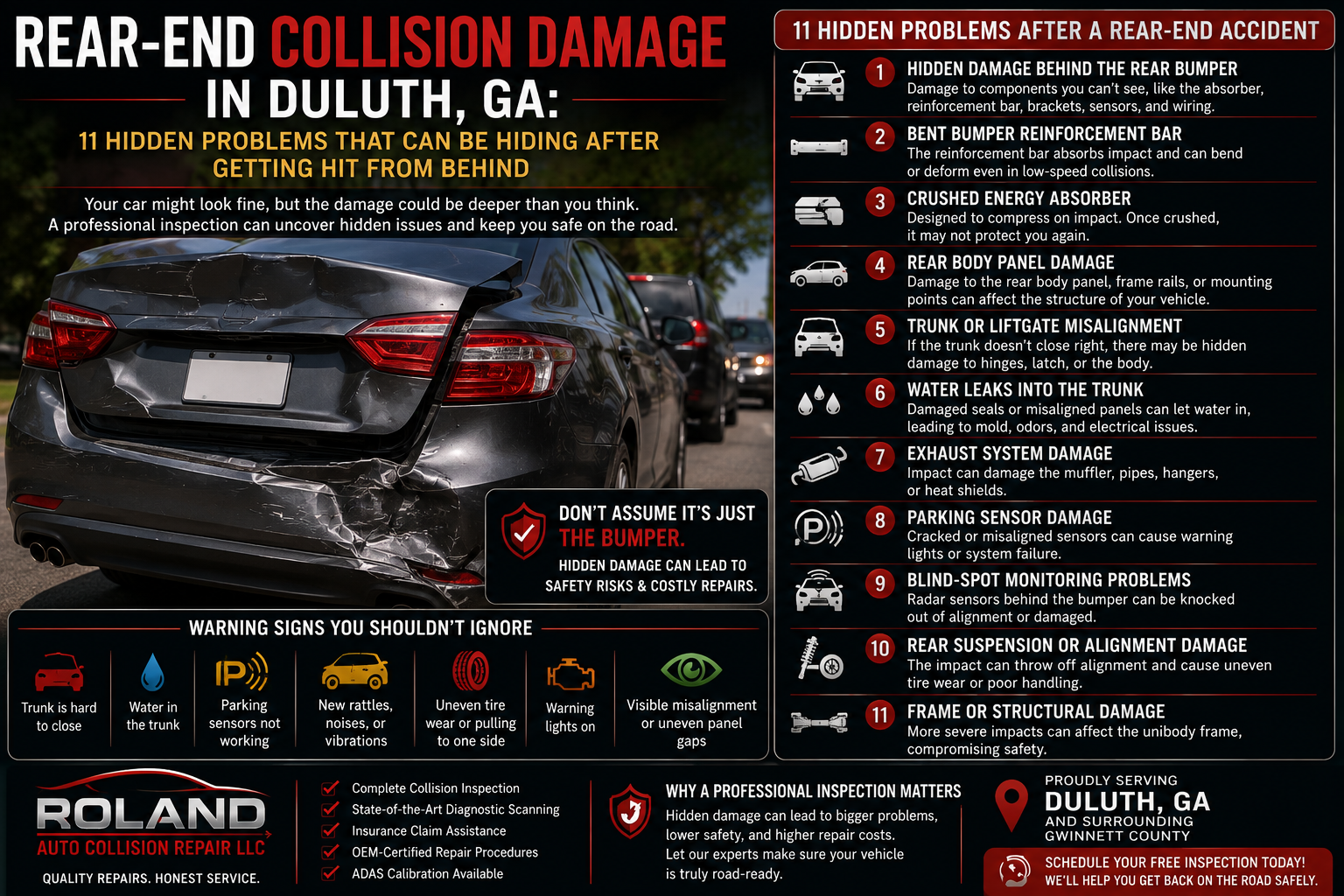
Here are 11 types of damage that can be hidden after a rear-end collision.
The painted bumper cover is usually the first thing drivers see.
Behind it may be the energy absorber, reinforcement bar, brackets, sensors, wiring, and structural mounting points.
The bumper cover can flex during an impact and partially return to its original shape.
That means the outside may look relatively normal even though components behind it absorbed significant force.
A proper inspection may require removing the bumper cover.
The reinforcement bar sits behind the outer bumper cover.
Its purpose is different from the cosmetic cover.
During a collision, it can bend, twist, crack, shift, or damage mounting points.
A bent reinforcement bar may not be visible until the bumper is disassembled.
Replacing only the bumper cover would not address this type of damage.
Many bumper systems contain an energy absorber.
This component may be designed to compress during an impact.
Once compressed or damaged, it may need replacement depending on manufacturer procedures.
Because it is hidden behind the bumper, the driver usually cannot inspect it without disassembly.
Behind the bumper is part of the vehicle's body structure.
A harder rear impact can potentially affect the rear body panel, trunk floor, mounting points, rear rails, and adjacent sheet metal.
Damage may appear as wrinkles, distortion, misalignment, cracks, or uneven gaps.
Some structural deformation may be subtle.
After a rear-end collision, the trunk or hatch may no longer line up properly.
Warning signs include the trunk being hard to close, the liftgate requiring extra force, a gap that is larger on one side, water entering the trunk, the weather seal not contacting evenly, or the trunk popping open unexpectedly.
Misalignment may indicate damage to hinges, latch, quarter panels, rear body panel, or structural mounting areas.
Even small alignment changes should be evaluated.
A collision can disturb body seams and weather seals.
After rain or washing the car, you may notice damp carpet, water in the spare tire well, musty odor, fogging, or moisture near tail lights.
Possible causes include a misaligned trunk, damaged weather stripping, cracked seam sealer, body distortion, or a broken tail-light seal.
Water leaks should not be ignored because moisture can damage interior materials and electrical components.
The exhaust system often extends near the rear bumper.
A collision may affect the muffler, exhaust tips, hangers, pipes, or heat shields.
Possible symptoms include rattling, exhaust hanging lower than normal, new exhaust noise, vibration, or exhaust tip misalignment.
If the exhaust was pushed forward during the impact, additional components may also need inspection.
Many newer vehicles have ultrasonic parking sensors integrated into the rear bumper.
After a collision, a sensor may become cracked, disconnected, misaligned, pushed inward, or damaged internally.
Possible symptoms include a constant warning tone, no parking alert, false alerts, a dashboard message, or intermittent operation.
A bumper that looks fine may still contain a damaged sensor.
Blind-spot radar sensors are often located behind the rear bumper near the corners of the vehicle.
These systems may support blind-spot warning, lane-change warning, and rear cross-traffic alert.
A rear or rear-corner collision can potentially affect sensor mounting or alignment.
Even small positioning changes may matter.
A harder rear impact can sometimes affect suspension or wheel-related components.
Drivers may notice the vehicle pulls, the steering wheel is off-center, tire wear changes, the vehicle feels unstable, the rear wheel looks misaligned, or a new vibration appears.
Suspension problems are especially worth investigating if the collision affected one rear corner.
More severe rear-end collisions can affect the vehicle's structural dimensions.
Possible clues include uneven panel gaps, trunk that does not close correctly, bumper that sits crooked, quarter panels that appear distorted, vehicle alignment changes, or tires that wear unevenly.
Modern vehicles often use unibody construction, meaning structural damage can involve integrated portions of the vehicle body rather than a traditional separate frame.
Why Rear-End Collision Damage Can Be Easy to Miss
Modern bumper covers are made from flexible materials.
During an impact, the cover may deform and then partially recover.
That can create the illusion that little damage occurred.
But the energy of the collision still had to go somewhere.
It may have been transferred into the reinforcement, absorber, mounting points, body structure, sensors, exhaust, or trunk area.
This is why visual appearance alone is not always enough to evaluate collision damage.
Do You Need an Inspection After a Minor Rear-End Accident?
It can be a good idea.
You should strongly consider an inspection if the bumper is cracked, the bumper is loose, the trunk does not close normally, warning lights appear, parking sensors malfunction, blind-spot warning changes, the vehicle vibrates, the exhaust sounds different, panel gaps are uneven, water enters the trunk, or you hear new rattles.
Can You Drive After Being Rear-Ended?
It depends on the damage.
The vehicle may not be safe to drive if the bumper is dragging, lights are damaged, exhaust is hanging, a tire is rubbing, the trunk will not latch, warning lights are active, the vehicle drives differently, or structural damage is suspected.
When uncertain, have the vehicle inspected before continuing to drive.
Rear-End Collision and ADAS Calibration
Modern rear bumpers may contain multiple sensors.
Depending on the vehicle, a collision may affect blind-spot radar, parking sensors, rear cross-traffic alert, backup camera, or other driver-assistance systems.
After certain repairs, manufacturer procedures may require sensor aiming, calibration, diagnostic scanning, and verification.
A quality collision repair should consider electronic safety systems, not just body panels.
What Is Pre-Repair Scanning?
Modern vehicles contain many electronic control modules.
A collision repair shop may use diagnostic scanning to check for fault codes, sensor errors, communication problems, and ADAS system faults.
Some issues may not immediately trigger a warning visible to the driver.
Scanning can provide additional information before and after repair.
Will Insurance Cover Hidden Damage?
Insurance estimates are often initially based on visible damage.
After the vehicle is disassembled, additional damage may be discovered.
Examples include reinforcement damage, crushed absorber, broken brackets, sensor damage, and structural damage.
The collision shop can document the additional repair needs and submit a supplement to the insurer.
Why Is the Insurance Estimate Lower Than the Body Shop Estimate?
Several reasons are possible.
The insurance estimate may have been written from photos, before disassembly, using different part assumptions, without hidden damage, or without calibration information.
The body shop's estimate may become more complete after the vehicle is physically inspected and disassembled.
Does the Insurance Company Choose My Body Shop?
No.
Georgia drivers generally have the right to choose their repair facility.
An insurance company may recommend a shop in its network, but the customer can choose where the vehicle is repaired.
How Long Does Rear-End Collision Repair Take?
Repair time depends on damage severity, parts availability, insurance approval, hidden damage, structural repair, paint work, ADAS calibration, and shop schedule.
A bumper-only repair may be relatively straightforward.
A collision involving the rear structure, sensors, trunk, and quarter panels can take significantly longer.
What Does Rear-End Collision Repair Involve?
The process may include initial inspection, damage documentation, diagnostic scan, disassembly, hidden damage inspection, insurance supplement if needed, structural repair, parts replacement, body repair, paint and refinishing, reassembly, calibration if required, and final inspection.
Not every vehicle needs every step.
The repair plan should match the actual damage and manufacturer procedures.
Can Rear-End Damage Affect Vehicle Value?
Poorly repaired collision damage can affect how the car looks, drives, and functions.
Potential issues include uneven gaps, paint mismatch, water leaks, sensor faults, alignment problems, and structural concerns.
A professional repair helps restore the vehicle as closely as practical to its pre-accident condition.
Rear-End Collision Repair in Duluth, GA
If you've been hit from behind, do not assume the damage is limited to what you can see.
Roland Auto Collision Repair LLC provides professional collision inspection and repair for drivers throughout Duluth, GA, Gwinnett County, and surrounding communities.
Our team can evaluate bumper damage, hidden damage, structural concerns, paint and refinishing, sensor-related issues, and insurance repair needs.
Whether the accident was a low-speed parking-lot impact or a more significant rear-end collision, getting the vehicle inspected can help ensure important damage is not missed.
Contact Roland Auto Collision Repair LLC today for an auto body and collision repair estimate in Duluth, GA.
Frequently Asked Questions
Can a rear-end accident cause hidden damage?
Yes. Damage can occur behind the bumper to reinforcement bars, absorbers, brackets, sensors, exhaust components, and vehicle structure.
Should I get my car inspected after a minor rear-end collision?
Yes, especially if you notice bumper damage, trunk problems, warning lights, sensor issues, noises, or changes in how the vehicle drives.
Can a rear-end collision damage the frame?
A harder collision can potentially affect structural areas of a unibody vehicle.
Can a rear-end accident damage blind-spot sensors?
Yes. Blind-spot radar sensors are commonly located near the rear corners of modern vehicles.
Why doesn't my trunk close after being rear-ended?
The impact may have affected the latch, hinges, body panel, quarter panel, or vehicle structure.
Will insurance pay for hidden collision damage?
It may, depending on the claim and coverage. Additional damage discovered during repair is often documented through a supplemental estimate.
Need Collision Repair in Duluth?
Roland's Auto Collision is here to help with honest estimates, quality workmanship, and insurance claim assistance.