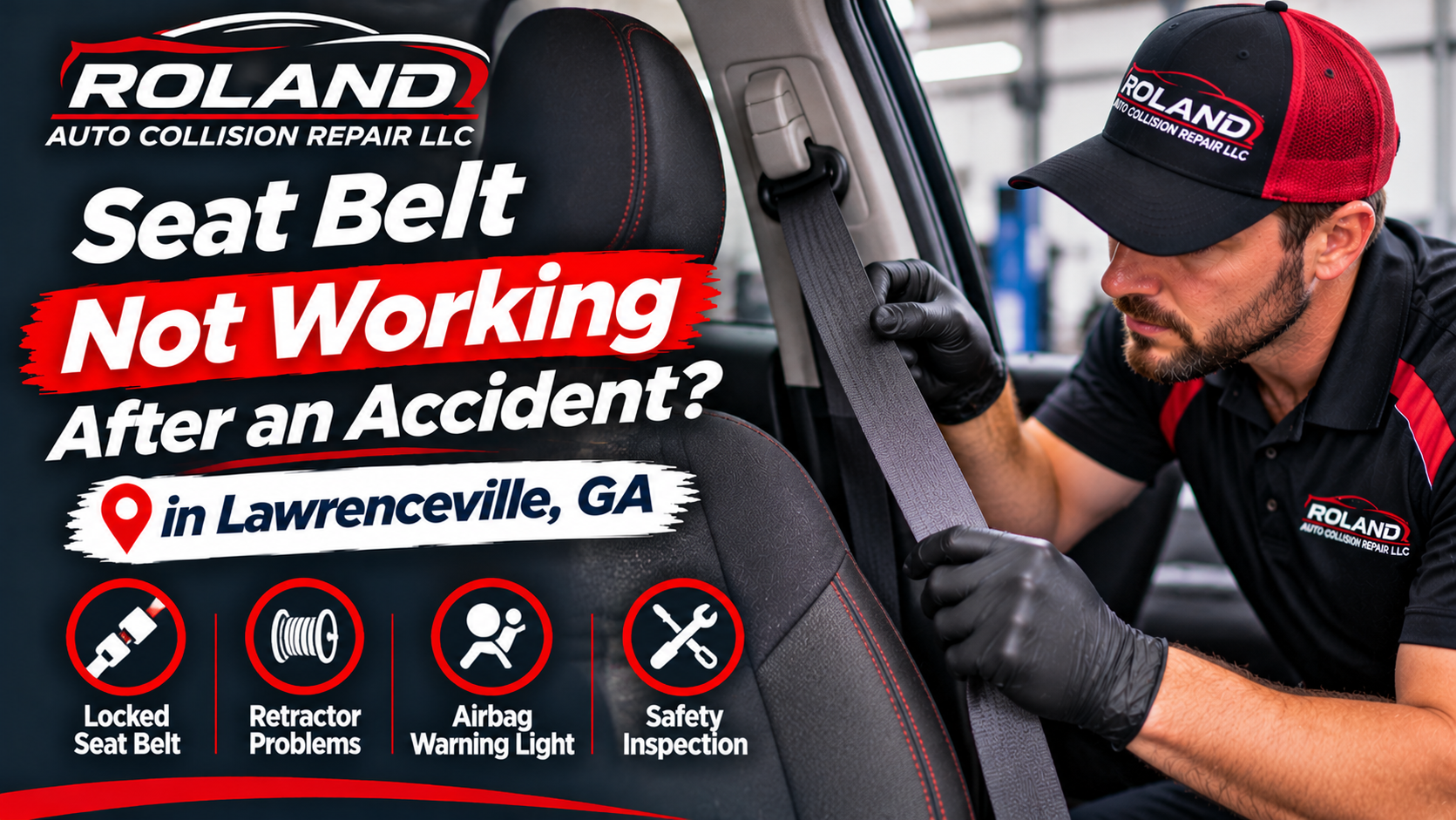
Seat Belt Not Working After an Accident? 7 Warning Signs for Lawrenceville, GA Drivers
After a car accident, most drivers immediately inspect their vehicle for dents, broken headlights, bumper damage, and scratched paint.
However, one of the most important components to inspect after a collision is your vehicle's seat belt system.
If your seat belt becomes stuck, won't retract, feels unusually loose, or displays a dashboard warning light, the problem may be related to collision damage.
For drivers in Lawrenceville, GA, understanding the warning signs of seat belt damage can help identify important safety issues before returning a vehicle to normal use.
At Roland Auto Collision Repair LLC, we provide professional collision repair and auto body services in Duluth, GA, serving drivers from Lawrenceville, Suwanee, Johns Creek, Norcross, Peachtree Corners, and surrounding Gwinnett County communities.
Here are seven warning signs that your seat belt system may have been affected by a collision.
Your Seat Belt Is Locked and Won't Pull Out
One of the most noticeable problems after a car accident is a seat belt that remains locked.
Modern seat belt systems contain locking mechanisms designed to help restrain occupants during sudden vehicle movements or collisions.
After an impact, a seat belt may remain locked because of a damaged retractor, activated pretensioner, or other restraint system problem.
Common warning signs include:
- Seat belt won't pull out
- Belt remains locked after the accident
- Retractor makes unusual noises
- Seat belt cannot be fastened properly
- Belt movement feels different than before the collision
A seat belt that remains locked should be inspected by a qualified repair professional.
Do not force the belt or attempt to bypass its locking mechanism.
The Seat Belt Won't Retract Properly
Your seat belt should retract smoothly when it is unbuckled.
If the belt remains loose or fails to retract, it may not function as designed.
Possible causes include:
- Damaged retractor components
- Twisted seat belt webbing
- Collision-related deformation
- Worn internal mechanisms
- Damage to the belt's mounting system
A seat belt that doesn't retract properly can compromise occupant restraint.
Professional diagnosis is important before the vehicle is returned to regular use.
Seat Belt Pretensioner Activation
Many modern vehicles are equipped with seat belt pretensioners.
These safety devices help tighten seat belts during certain collisions to reduce occupant movement.
Some pretensioners use a pyrotechnic mechanism that activates during an impact.
Once activated, these components generally require replacement according to the vehicle manufacturer's repair procedures.
Signs of possible pretensioner activation include:
- Seat belt remaining locked
- Airbag or restraint system warning lights
- Changes in belt tension
- Diagnostic trouble codes
- Evidence of restraint system deployment
Pretensioner replacement and related repairs should follow manufacturer procedures.
Although ADAS and seat belt pretensioners are different safety systems, both demonstrate why modern collision repairs involve more than exterior bodywork.
Airbag Warning Light Stays On
If your airbag or supplemental restraint system warning light remains illuminated after an accident, the vehicle may have a fault involving its restraint system.
Possible causes include:
- Activated seat belt pretensioners
- Damaged restraint system wiring
- Faulty sensors
- Airbag deployment components
- Electrical connections affected by the collision
A warning light does not automatically identify the exact problem.
Professional diagnostic scanning and manufacturer-approved procedures may be required to determine the cause.
Never ignore an illuminated restraint system warning light after a collision.
Seat Belt Webbing Is Torn, Frayed, or Damaged
Seat belt webbing is engineered to withstand substantial forces during a collision.
However, belts can become damaged through impact loading, abrasion, cutting, or contact with damaged interior components.
Inspect for visible warning signs such as:
- Frayed edges
- Torn fabric
- Cuts or holes
- Melted or heat-damaged areas
- Unusual stretching
- Damaged stitching
A visibly damaged seat belt should not be considered safe simply because it still buckles.
Replacement may be required under the manufacturer's instructions.
Seat Belt Buckle Won't Latch or Release Correctly
A damaged seat belt buckle can prevent the belt from securing properly.
After a collision, the buckle assembly or its mounting components may be affected by impact forces or interior deformation.
Warning signs include:
- Buckle won't click into place
- Seat belt releases unexpectedly
- Buckle is difficult to operate
- Visible damage around the buckle
- Buckle mounting position has changed
The buckle and related components should be inspected before the seat is used.
Hidden Damage to Seat Belt Mounting Points
Seat belts attach to reinforced mounting points in the vehicle's body or seat structure.
During a significant collision, these attachment areas may experience considerable force.
Even when the belt appears undamaged, the mounting structure may need inspection.
Possible concerns include:
- Bent seat mounting brackets
- Damaged floor or pillar structure
- Deformed seat belt anchors
- Interior panel displacement
- Hidden structural damage near restraint components
Professional collision repair involves evaluating the vehicle's structural integrity as well as visible cosmetic damage.
Do Seat Belts Need to Be Replaced After Every Accident?
Not necessarily.
Seat belt replacement requirements depend on the vehicle manufacturer's procedures, collision severity, restraint system activation, and condition of the components.
Some manufacturers require replacement of certain seat belt components after specific types of collisions, even when damage is not obvious.
A qualified repair professional should review the applicable manufacturer repair instructions before determining whether a seat belt can remain in service.
Can You Drive With a Damaged Seat Belt?
A damaged seat belt can place vehicle occupants at risk.
If a seat belt won't latch, retract, or operate correctly, the affected seating position should not be used.
If the driver's seat belt is damaged or the vehicle has other significant safety concerns, arrange for professional inspection or transportation rather than driving.
Will Insurance Cover Seat Belt Replacement?
Seat belt replacement may be included in an insurance claim when the damage results from a covered collision.
Coverage depends on the policy, accident circumstances, and insurance company's evaluation.
A professional collision inspection can help document damaged restraint system components and identify repairs required under manufacturer procedures.
Drivers should also understand their options when selecting an auto body shop.
Why Professional Collision Inspections Matter
Modern vehicles contain complex safety systems designed to work together during an accident.
These systems may include:
- Seat belts
- Pretensioners
- Airbags
- Crash sensors
- Electronic restraint control modules
- Vehicle structural components
- Advanced driver assistance systems
A collision can affect several of these systems simultaneously.
A professional collision repair inspection helps identify visible damage and determine which additional diagnostic procedures are necessary.
Frequently Asked Questions About Seat Belt Damage
Why is my seat belt locked after a car accident?
The retractor or pretensioner may have activated or become damaged during the collision. Professional inspection is necessary to identify the cause.
Can a seat belt be repaired after an accident?
Repair or replacement requirements depend on the specific component and vehicle manufacturer's instructions. Many damaged or activated restraint components require replacement rather than repair.
Do Seat Belts Need Replacement After Airbag Deployment?
Certain seat belt components may require replacement following airbag deployment or pretensioner activation. Always follow the applicable manufacturer procedures.
Is a seat belt warning light serious?
Yes. A restraint system warning light may indicate a fault that affects occupant protection during a future collision.
Can an auto body shop inspect seat belt damage?
A collision repair facility can assess accident-related damage and determine whether additional restraint system diagnostics or specialized repairs are required.
Where can I get collision repair near Lawrenceville, GA?
Roland Auto Collision Repair LLC is located in Duluth, GA, and serves drivers from Lawrenceville and surrounding Gwinnett County communities.
Professional Collision Repair Near Lawrenceville, GA
If your seat belt stopped working after an accident, don't overlook the problem.
Collision damage can affect important safety components even when the exterior damage appears relatively minor.
Roland Auto Collision Repair LLC provides professional collision repair and auto body services in Duluth, serving Lawrenceville, Suwanee, Johns Creek, Norcross, Peachtree Corners, and surrounding Gwinnett County communities.
Our team can evaluate visible collision damage and help identify when manufacturer-required safety system inspections or specialized repairs are necessary.
Contact Roland Auto Collision Repair LLC to discuss your vehicle's collision damage and request a repair estimate.
Roland Auto Collision Repair LLC — Professional Collision Repair in Duluth, Georgia.
Need Collision Repair in Duluth?
Roland's Auto Collision is here to help with honest estimates, quality workmanship, and insurance claim assistance.